
The Data Paradox in Telecom
Telecom operators hold some of the richest customer data of any industry: usage, top-ups, location patterns, device types, support history. Yet that data typically sits in disconnected systems, so marketing sees one version of the customer and care sees another.
A CDP closes that gap. Instead of campaigns built on stale segments, teams act on a live, unified view of every subscriber.
What Is a Customer Data Platform?
A CDP is software that collects customer data from multiple sources, resolves it into a single profile per person, and makes that profile available to marketing, sales and service tools. Unlike a traditional data warehouse, it is built for activation, not just storage.
CDP vs CRM vs Data Warehouse
- CRM records interactions managed by sales and support teams.
- Data warehouse stores large volumes of historical data for analysis.
- CDP unifies identity and activates data across channels in near real time.
Core Capabilities of a Telecom CDP
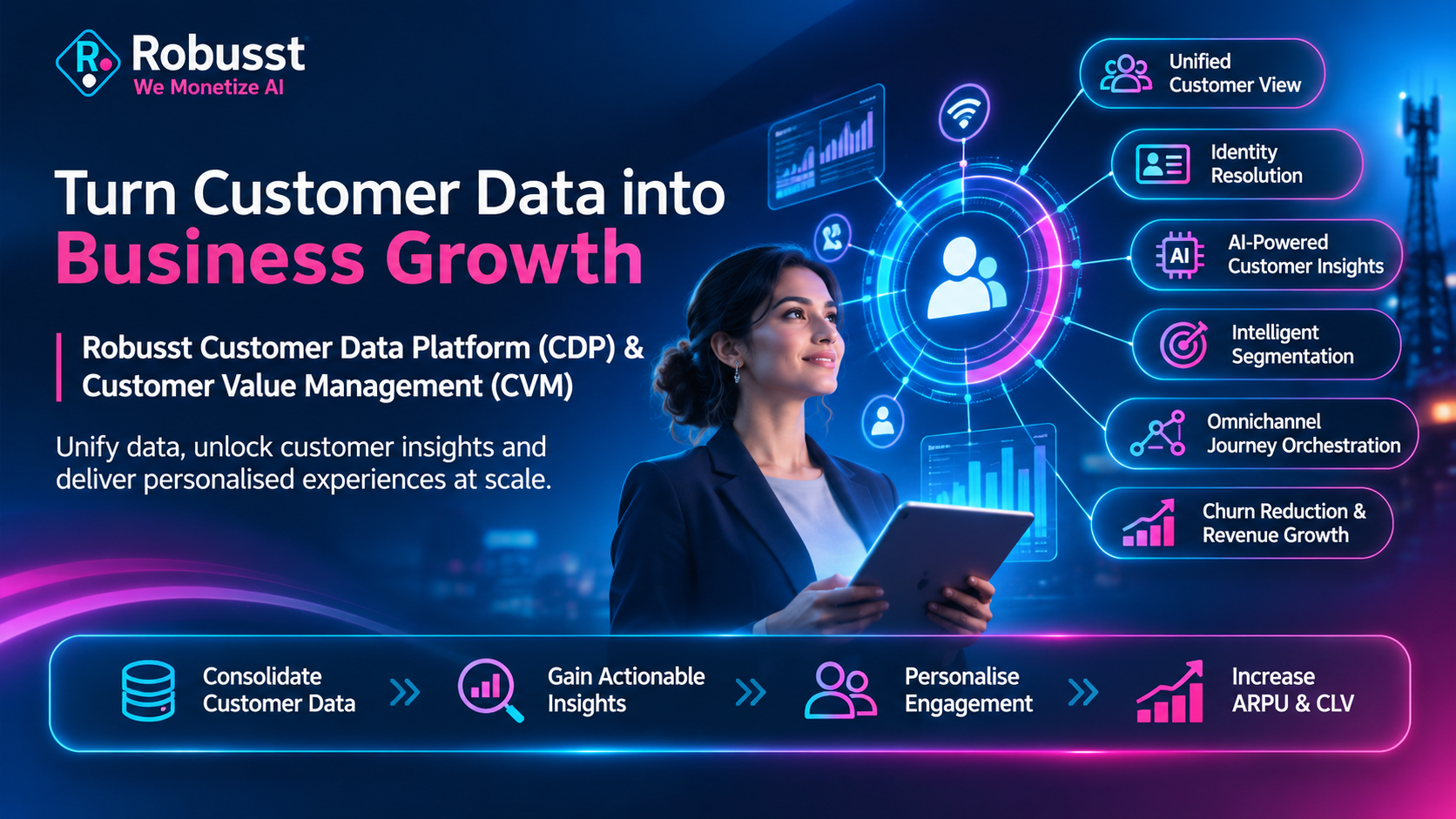
Unified Subscriber Profile
Billing, usage, device, app and care data are stitched into one profile, so every team works from the same facts.
Segmentation and Audience Building
Operators can build segments such as high-value prepaid users likely to upgrade, roaming travellers, or data-heavy users approaching their cap.
Predictive Analytics for Churn
Machine learning models flag subscribers showing early warning signs, such as falling usage or repeated network complaints, so retention offers go out before they leave.
Real-Time Personalisation
Offers, bundles and messages adapt to behaviour as it happens, across SMS, app, USSD, email and call centre.
Why Personalisation Matters
McKinsey research on personalisation found that companies which excel at it generate meaningfully higher revenue from those activities than average performers, with its widely cited estimate around 40 percent more. Verify the exact figure at the McKinsey source before publishing. For operators in competitive, price-driven markets, personalisation is one of the few levers that improves both ARPU and loyalty.
Practical Use Cases
- Churn reduction: trigger retention bundles when a subscriber's usage pattern changes.
- Cross-sell and upsell: offer data packs, VAS or fintech services based on behaviour.
- Campaign ROI measurement: link each campaign to actual recharge and usage outcomes.
- Customer care: agents see the full journey, reducing repeat explanations.
- Consent and privacy management: centralise opt-ins to support data protection compliance.
Business Benefits
- Higher ARPU through relevant, timely offers
- Lower churn through predictive retention
- Faster campaign launches and less reliance on IT
- Clearer view of marketing performance
- Stronger governance over customer consent
How Robusst Helps
Robusst's CDP is designed for CSPs, combining unified profiles, AI-driven segmentation and predictive models with integration into existing billing, CRM and network systems. You can read more about our approach in the post AI-Powered Customer Insights: Unlocking Telecom Revenue Growth.
Frequently Asked Questions
What is a customer data platform in telecom? It is a system that unifies subscriber data from all sources into a single real-time profile, which marketing and service teams can use to personalise engagement.
How is a CDP different from a CRM? A CRM manages recorded interactions. A CDP unifies data from many systems and activates it in real time across channels.
Can a CDP reduce telecom churn? Yes. Predictive models identify at-risk subscribers, and the CDP triggers targeted retention actions before they leave.
What data sources does a telecom CDP use? Billing, usage records, CRM, digital apps, care interactions, device data and consented third-party data.
How long does implementation take? It depends on data readiness and integrations. Many operators begin with a focused use case, such as churn or upsell, and expand.
Conclusion
Subscriber data is only valuable when it is unified and acted on. A CDP gives telecom operators that single view and the intelligence to turn it into retention and revenue.
Want to see what a unified subscriber view could do for your ARPU? Contact Robusst at contact@robusst.com to book a CDP walkthrough.