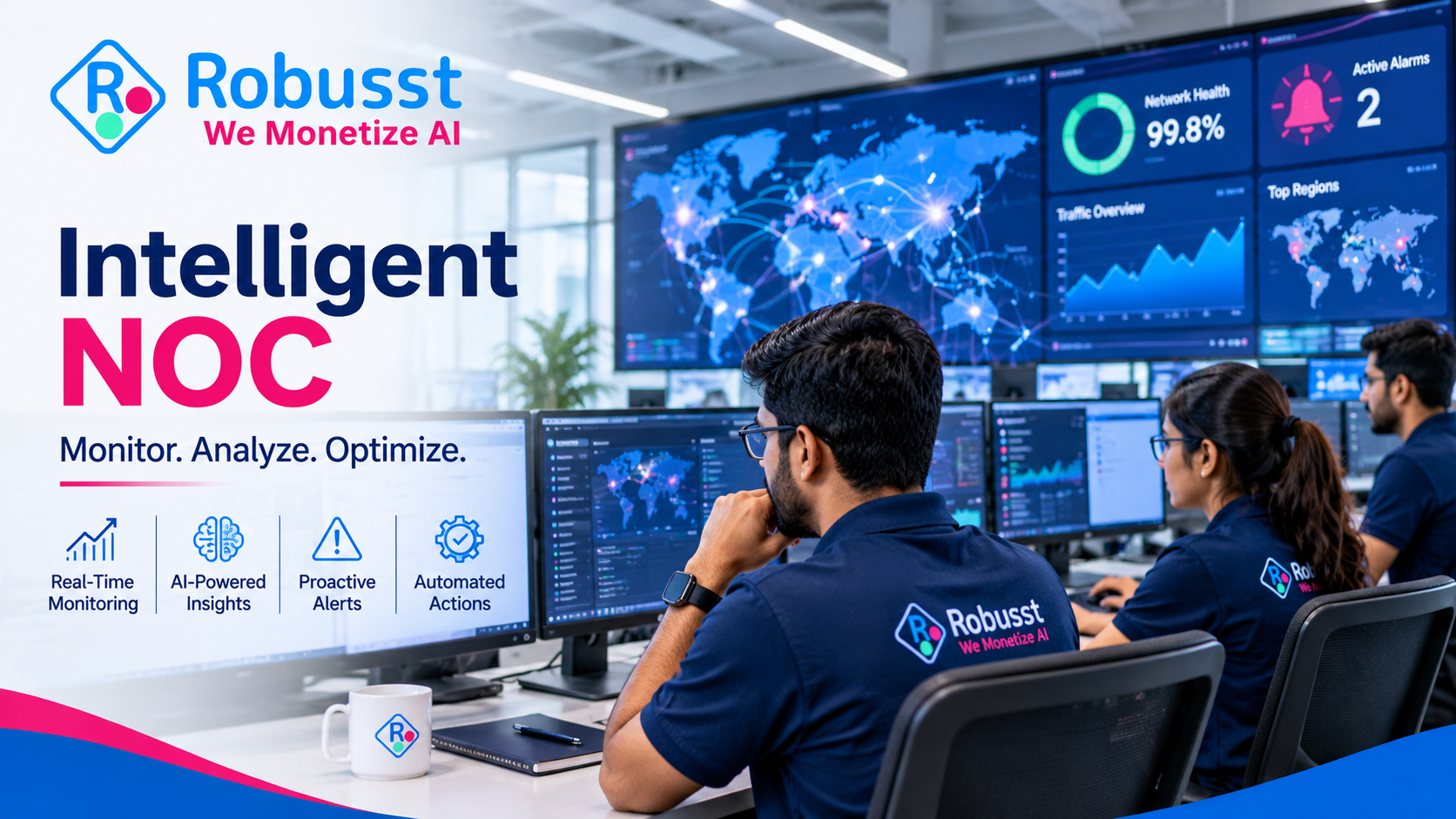
Quick answer: An intelligent Network Operations Center (NOC) uses AI and automation to monitor the whole network from one view, detect problems early, find the root cause quickly and trigger fixes automatically. For telecom operators it means less downtime, faster incident response and lower operating cost.
Why Traditional NOCs Struggle
A telecom network produces a constant stream of alarms from radio, transport, core, IT and cloud systems. In a traditional NOC, engineers watch separate tools, sort through floods of alerts and raise tickets by hand. A single fault can trigger hundreds of related alarms, and the real cause is buried among them.
The result is slow detection, long resolution times and engineers spending their day on repetitive triage instead of improving the network. As networks add 5G, virtualised functions and cloud-native cores, the manual approach stops scaling.
What Is an Intelligent NOC?
An intelligent NOC is a network operations platform that combines centralised monitoring with machine learning, event correlation and automated workflows. Instead of only displaying alarms, it understands them, links them to the real cause and, where policy allows, acts on them.
Intelligent NOC vs Traditional NOC
- Traditional NOC: many tools, manual triage, reactive fixes, long recovery times.
- Intelligent NOC: one unified view, AI-driven detection, automated correlation and response, predictive insight.
Core Capabilities of an Intelligent NOC
Unified Network Monitoring
Performance, availability and fault data from multiple vendors and domains appear in a single dashboard, so teams stop switching between tools.
AI-Powered Anomaly Detection
Machine learning learns what normal looks like for each element and flags unusual behaviour early, often before customers are affected.
Event Correlation and Root Cause Analysis
Hundreds of related alarms are grouped into a single incident with a likely root cause, cutting noise and speeding diagnosis.
Automated Incident Response
Routine actions such as ticket creation, escalation, restarts and configuration checks run automatically, with human approval where needed.
Predictive Analytics
Trend analysis helps predict capacity shortfalls and hardware or link degradation so that teams can act before an outage.
Dashboards and Reporting
Live service-quality views and SLA reports give operations and management the same trusted picture.
How an Intelligent NOC Works
- Collect: data streams in from network elements, probes, logs and IT systems.
- Detect: AI models find anomalies and degradation against learned baselines.
- Correlate: related events are merged into one incident and ranked by service impact.
- Respond: automated workflows open tickets, notify teams and run approved fixes.
- Learn: outcomes feed back into the models, so detection improves over time.
Practical Use Cases
- Outage prevention: spot a degrading link or overloaded node and fix it before it fails.
- Alarm noise reduction: turn alarm storms into a short list of actionable incidents.
- Faster root cause analysis: trace a customer-facing issue back to the failing element quickly.
- Capacity planning: forecast traffic growth and plan upgrades with data.
- SLA assurance: monitor enterprise and wholesale service levels in real time.
- Multi-vendor operations: manage mixed-vendor networks from one place.
Business Benefits for Telecom Operators
- Less downtime and fewer customer-affecting incidents
- Faster detection and shorter time to repair
- Lower operating cost through automation
- Engineers freed from repetitive triage for higher-value work
- Better customer experience, and lower churn as a result
- A stronger basis for moving toward autonomous network operations
How Robusst Helps
Robusst's Intelligent NOC provides centralised network monitoring and incident management powered by intelligent automation, with AI-based alerting and analytics dashboards. It works alongside Robusst's Cyber Security and Network Monetization solutions, so operations, security and revenue teams can share one picture of network health.
Frequently Asked Questions
What is an intelligent NOC?
It is a network operations center that uses AI, automation and unified monitoring to detect, diagnose and resolve network issues faster than manual processes.
How is an intelligent NOC different from a traditional NOC?
A traditional NOC relies on separate tools and manual triage. An intelligent NOC correlates alarms automatically, finds root causes and automates routine responses.
Can an intelligent NOC reduce network downtime?
Yes. By detecting anomalies early and automating the response, it shortens detection and repair times and can prevent some incidents altogether.
Does it work with multi-vendor networks?
Yes. A good intelligent NOC integrates data from multiple vendors and domains into one view.
Will automation replace NOC engineers?
No. Automation handles repetitive tasks and engineers focus on complex issues, planning and improvement.
Conclusion
Networks are growing more complex every year, and manual operations cannot keep up. An intelligent NOC gives telecom operators earlier warning, faster fixes and a clear path toward automated operations.
Ready to move from reactive firefighting to proactive network operations? Contact Robusst at contact@robusst.com to see the Intelligent NOC in action.